
Introduction to Pressure Gauges
A Pressure Gauge is a vital instrument used to measure the pressure of gases or liquids within a system, ensuring safe and efficient operation across industrial processes. It converts applied pressure into mechanical displacement, which is then indicated on a calibrated dial.
The most widely used mechanism is the Bourdon tube principle, where a curved elastic tube tends to straighten when internal pressure is applied. This movement is transmitted via a linkage mechanism to a pointer, providing a direct pressure reading.
Pressure gauges are preferred in industrial environments because they:
- Do not require external power
- Are rugged and reliable
- Offer real-time indication
- Are cost-effective for continuous monitoring
They are extensively used across industries such as oil & gas, chemical processing, pharmaceuticals, power plants, food processing, water treatment, and HVAC systems.
Working Principle of Pressure Gauge
Pressure gauges operate based on the elastic deformation principle.
When pressure enters the sensing element:
- The element (Bourdon tube/diaphragm/capsule) deforms
- This deformation is proportional to the applied pressure
- The movement is transferred to a pointer via gears
- The pointer indicates the pressure on a calibrated scale
Common measuring units include:
- Bar
- PSI
- kg/cm²
- MPa
Types of Pressure Gauges
1. Bourdon Tube Pressure Gauge :
- Most commonly used type
- Suitable for medium to high pressure
- Available in C-type, helical, and spiral designs
- Widely used in general industrial applications
2. Diaphragm Pressure Gauge
- Uses a flexible diaphragm
- Ideal for low pressure and corrosive media
- Often used with chemical seals
3. Capsule Pressure Gauge
- Designed for very low pressure measurement
- Highly sensitive
- Used in gas flow and laboratory applications
4. Differential Pressure Gauge
- Measures difference between two pressure points
- Used in filter monitoring, flow measurement, cleanrooms
5. Digital Pressure Gauge
- Electronic sensor-based
- High accuracy and readability
- Used where precision is critical
6. Vacuum Gauge
- Measures pressure below atmospheric level
- Used in vacuum pumps and systems
- Special Features & Advanced Configurations
- Glycerine Filled Pressure Gauge (Liquid Filled Gauges)
Glycerine-filled gauges are used in environments where vibration, pulsation, or pressure shocks are present.
Where to use:
Pumps and compressors
Hydraulic systems
Heavy machinery
Marine and mobile equipment
Advantages:
Dampens pointer fluctuations
Increases gauge life
Improves readability
Protects internal components
Note: Silicone oil filling is used for high-temperature applications where glycerine may not be suitable.
External Zero Adjustment
External zero adjustment allows the user to correct the pointer position without opening the gauge.
Where it is useful:
Field calibration
Applications with frequent pressure variation
Systems requiring high accuracy
Benefits:
Saves maintenance time
Eliminates need to dismantle gauge
Ensures consistent accuracy
PP (Polypropylene) Pressure Gauges for Corrosive Environments
PP gauges are specially designed for highly corrosive environments where standard SS or brass gauges may fail.
Where to use:
Chemical industries
Acid handling plants
Fertilizer plants
Effluent treatment plants (ETP/STP)
Electroplating industries
Construction:
Wetted parts made of Polypropylene (PP)
Often combined with diaphragm seals
Advantages:
Excellent chemical resistance
Lightweight and durable
Cost-effective solution for corrosive media
Selection Criteria for Pressure Gauges
Choosing the right pressure gauge is critical for performance and safety.
Key Parameters:
Pressure range (select 1.5 to 2 times working pressure)
Type of fluid (gas/liquid/corrosive)
Operating temperature
Vibration and pulsation conditions
Accuracy requirement
Mounting type (bottom/back)
Material Selection:
Brass → General applications
SS316L→ Corrosive & hygienic environments
PP → Highly corrosive chemicals
Accuracy of Pressure Gauges
Accuracy is expressed as a percentage of Full Scale (FS).
Typical Accuracy Classes:
- ±0.1% to ±0.25% → Calibration & laboratory
- ±0.5% to ±1% → Process industries
- ±1.6% to ±2.5% → General applications
Factors Affecting Accuracy:
Temperature variation
Mechanical wear
Vibration
Improper installation
Lack of calibration
Regular calibration ensures consistent performance and reliability.
Industrial Applications of Pressure Gauges
Pressure gauges play a critical role in monitoring and control:
- Oil & Gas: Pipeline pressure monitoring
- Chemical Industry: Handling aggressive fluids
- Pharmaceutical: Hygienic and sterile processes
- Power Plants: Boiler and steam pressure
- Food Industry: Process safety and hygiene
- Water Treatment: Pump and filtration systems
Introduction to Temperature Gauges
A temperature gauge is an essential instrument used to measure the temperature of liquids, gases, or surfaces in industrial systems. It ensures process safety, efficiency, and quality control across various applications.
Temperature gauges convert thermal energy into mechanical movement, which is displayed on a calibrated dial for direct reading.
The most widely used types are:
- Bimetallic Temperature Gauges
- Gas Filled Temperature Gauges
Why temperature gauges are widely used:
- No external power required
- Rugged and durable design
- Real-time temperature indication
- Suitable for harsh industrial environments
- Cost-effective for continuous monitoring
They are extensively used in industries such as oil & gas, chemical processing, power plants, HVAC, food processing, pharmaceuticals, and water treatment.
Working Principle of Temperature Gauges
Temperature gauges operate based on thermal expansion principles.
Bimetallic Type:
- Uses two dissimilar metals bonded together
- Different expansion rates cause bending when heated
- This movement rotates a pointer via a mechanical linkage
- Temperature is displayed on a dial
- Gas Filled Type:
- Consists of a bulb, capillary, and sensing element
- Filled with gas (usually nitrogen or inert gas)
- Temperature change causes pressure variation inside the system
- This pressure moves the sensing element and pointer
Common units:
- °C (Celsius)
- °F (Fahrenheit
Types of Temperature Gauges
1. Bimetallic Temperature Gauge
- Most commonly used mechanical temperature gauge
- Suitable for medium temperature ranges
- Available in stem type and surface mounting
- Cost-effective and robust
2. Gas Filled Temperature Gauge
- Uses gas expansion for measurement
- Suitable for long-distance sensing
- High accuracy and fast response
- Ideal for remote installations
- Special Features & Advanced Configurations
- Liquid Filled Temperature Gauge
(Usually glycerine or silicone filled)
Used in applications with vibration or pulsation.
Applications:
- Compressors
- Engines
- Hydraulic systems
- Heavy machinery
Advantages:
- Dampens pointer vibration
- Improves readability
- Increases instrument life
Silicone oil is preferred for high-temperature environments.
Thermowell Protection
Thermowells are protective sleeves installed between the process and the temperature sensor.
Where to use:
- High pressure systems
- Corrosive environments
Flowing media
Benefits:
- Protects the sensor from damage
- Allows removal without shutting down process
- Increases service life
- Capillary Type (Remote Mounting)
Used in gas-filled gauges where the sensing bulb is far from the display.
Applications:
- Boilers
- HVAC systems
- Oil tanks
Advantages:
- Remote measurement capability
- Flexible installation
- Accurate readings over distance
- Selection Criteria for Temperature Gauges
Choosing the correct temperature gauge is essential for reliable performance.
Key Parameters:
- Temperature range (select 1.5 times operating temperature)
- Type of application (local or remote sensing)
Stem length and diameter - Response time requirement
- Vibration conditions
- Mounting type (bottom/back/adjustable)
Material Selection:
- Brass → General applications
- SS304/SS316 → Corrosive and hygienic environments
- Special coatings → Chemical exposure
- Accuracy of Temperature Gauges
Accuracy is expressed as a percentage of Full Scale (FS).
Typical Accuracy Classes:
- ±1% → Standard industrial use
- ±2% → General applications
Higher accuracy available for critical processes
Factors Affecting Accuracy:
- Ambient temperature changes
- Mechanical wear
- Improper installation
- Poor thermal contact
- Lack of calibration
Regular calibration ensures consistent performance.
Industrial Applications of Temperature Gauges
Temperature gauges are critical for monitoring and control:
- Oil & Gas: Pipeline and storage temperature
- Chemical Industry: Reaction temperature control
- Power Plants: Boiler and steam temperature
- HVAC: Air and water temperature monitoring
- Food Industry: Process and storage temperature
- Pharmaceutical: Sterile and controlled environments
- Water Treatment: Process and system monitoring.
Introduction Of Thermocouple
A Thermocouple is a type of temperature sensor that measures temperature by using the phenomenon of thermoelectricity. It consists of two different metals or alloys that are joined together at one end to form a measuring junction. The other end of each metal is connected to a measuring instrument, typically a voltmeter.
When the measuring junction of a thermocouple is exposed to a temperature difference, a small voltage is generated due to the Seebeck effect. This voltage is proportional to the temperature difference between the junction and a reference point, typically the cold junction or the temperature of the thermocouple wire where it connects to the measuring instrument.
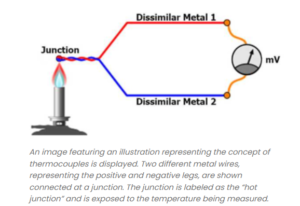
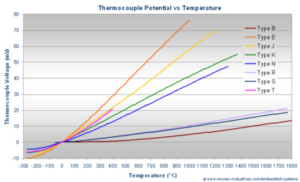
The output of a thermocouple is nonlinear, meaning that the voltage produced is not directly proportional to the temperature being measured. As a result, the voltage-to-temperature relationship is typically described by a lookup table or polynomial equation.
Thermocouples are widely used in industrial and scientific applications for temperature measurement because they are simple, rugged, and can measure over a wide temperature range. They are commonly used in plastic and packaging , furnaces, ovens, kilns, and many other high-temperature environments where other types of temperature sensors may not be suitable.
Types of thermocouple
There are several types of thermocouples, each with different materials used for the two wires that make up the thermocouple. The most common types of thermocouples are below
Type K: composed of chromel (an alloy of nickel and chromium) and alumel (an alloy of nickel, aluminum, manganese, and silicon), commonly used for general-purpose applications in the range of -100 to 1200 degrees Celsius.
Type J: composed of iron and constantan (a copper-nickel alloy), commonly used in industrial applications in the range of -100 to 700 degrees Celsius.
Type T: composed of copper and constantan, commonly used in low-temperature applications in the range of -150 to 350 degrees Celsius.
Type E: composed of chromel and constantan, commonly used in cryogenic applications in the range of -270 to 1000 degrees Celsius.
Type N: composed of nicrosil (an alloy of nickel, chromium, and silicon) and nisil (an alloy of nickel and silicon), commonly used in high-temperature applications in the range of -270 to 1300 degrees Celsius.
Type S and Type R: composed of platinum and a platinum-rhodium alloy, commonly used in high-temperature applications in the range of 0 to 1750 degrees Celsius.
Each type of thermocouple has its own unique characteristics, such as temperature range, accuracy, and stability, which make them suitable for different applications.
Accuracy Of A Thermocouple
The accuracy of a thermocouple depends on various factors such as the type of thermocouple, the materials used, the temperature range, and the measurement system used. Here are the typical accuracies for the common types of thermocouples:
- Type K : +/- 2.2°C or +/- 0.75% above 0°C, whichever is greater.
- Type J: +/- 2.2°C or +/- 0.75% above 0°C, whichever is greater.
- Type T: +/- 1°C or +/- 0.75% above 0°C, whichever is greater.
- Type E: +/- 1.7°C or +/- 0.5% above 0°C, whichever is greater.
- Type N: +/- 2.2°C or +/- 0.75% above 0°C, whichever is greater.
- Type S: +/- 1.5°C or +/- 0.25% above 750°C, whichever is greater.
- Type R: +/- 1.5°C or +/- 0.25% above 750°C, whichever is greater.
Accuracy of a thermocouple may also depend on the calibration of the measuring instrument and the measurement technique used. In general, the accuracy of a thermocouple improves with better temperature resolution and stability of the measurement system.
Introduction Of RTD sensor
An RTD sensor, also known as a Resistance Temperature Detector, is a type of temperature sensor that operates on the principle of electrical resistance. It is made up of a metal wire, usually platinum, that is wound into a coil and encased in a protective sheath.
The resistance of the metal wire changes in a predictable way as the temperature changes, and this change in resistance can be used to measure the temperature. RTDs are commonly used in industrial and scientific applications where high accuracy and stability are required.
One of the key advantages of RTD sensors is their high accuracy and stability over a wide temperature range. They are also highly repeatable, meaning that the same sensor will provide the same reading for the same temperature, time after time. RTDs are often used in applications where precise temperature control is critical, such as in chemical processing, aerospace, and automotive industries.

Accuracy Of RTD sensor

Class A and Class B are two commonly used classifications for Resistance Temperature Detectors (RTDs), which are types of temperature sensors that measure temperature by the change in resistance of a metal wire as temperature changes.
Class A RTD sensors are designed for use in high-precision applications, where the highest accuracy is required. These sensors typically have a tolerance of ±0.15% or better at 0°C and a temperature range of -200°C to 500°C. Class A RTD sensors are commonly used in laboratory and industrial applications where high accuracy is required.
Class B RTD sensors are also designed for high-precision applications, but with slightly lower accuracy than Class A sensors. These sensors typically have a tolerance of ±0.3% at 0°C and a temperature range of -200°C to 600°C. Class B RTD sensors are commonly used in industrial applications where high accuracy is required but not at the same level as Class A sensors.
Types Of RTD Sensor Based On Resistance
RTD (Resistance Temperature Detector) sensors are classified based on the resistance of the sensing element at 0°C. The most common types of RTD sensors are PT100 and PT1000, which have resistances of 100 ohms and 1000 ohms at 0°C, respectively.
There are also other types of RTD sensors with different resistance values, including PT50, PT200, PT500, PT5000, and PT10000, which have resistances of 50 ohms, 200 ohms, 500 ohms, 5000 ohms, and 10000 ohms at 0°C, respectively. These sensors are less commonly used than PT100 and PT1000 sensors, but they can be useful in some applications that require different sensitivity or temperature ranges

It’s important to note that the resistance of an RTD sensor varies with temperature, and the change in resistance is used to measure the temperature. The resistance values listed above are the nominal or reference values at 0°C, and the actual resistance values at other temperatures depend on the specific design and materials used for the RTD sensor.
Types Of RTD Sensor Based On Wire Configuration
There are three types of RTD (Resistance Temperature Detector) based on the number of wires used for their connection:

2-wire RTD
This is the simplest configuration, where the RTD is connected using two wires. However, this configuration is not very accurate, as it does not account for any resistance in the wires themselves.
3-wire RTD
Thconfiguration is is the most commonly used RTD circuit design and can be seen in industrial process and monitoring applications. This configuration is more accurate than the 2-wire RTD. It uses three wires, with two wires carrying the RTD resistance and the third wire carrying the lead resistance, which can be canceled out.
4-wire RTD
This is the most accurate configuration, as it eliminates any lead resistance. In this configuration, two wires are used to carry the RTD resistance, while the other two wires are used to carry a current to measure the voltage across the RTD.
Thermocouples and RTD (Resistance Temperature Detectors) sensors are both commonly used in industrial temperature measurement applications. Here are the following chart between the two
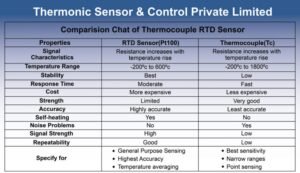
Overall, the choice between a thermocouple and an RTD sensor depends on the specific requirements of the application, such as temperature range, accuracy, response time, and cost.
The insulation material used in thermocouple wire is important for maintaining the accuracy of the temperature measurement and protecting the wire from environmental factors. Here are some common types of insulation materials used in thermocouple wire:
- PVC: Polyvinyl chloride (PVC) is a common insulation material for low-temperature applications. It is resistant to oils, chemicals, and moisture.
- Teflon (PTFE): Teflon, also known as polytetrafluoroethylene (PTFE), is a common insulation material for high-temperature applications. It is resistant to oils, chemicals, and moisture and can withstand temperatures up to 260°C (500°F).
- Fiberglass: Fiberglass is commonly used in high-temperature applications. It is resistant to moisture, chemicals, and oils and can withstand temperatures up to 480°C (900°F).
- Ceramic Fiber: Ceramic fiber is a high-temperature insulation material that can withstand temperatures up to 1260°C (2300°F). It is resistant to chemicals, oils, and moisture.
- Mineral Insulated: Mineral insulated (MI) cable is a high-temperature insulation material that is used in thermocouples that require high accuracy and fast response times. The cable consists of a metal sheath filled with magnesium oxide powder, which provides excellent thermal conductivity and insulation.
The choice of insulation material depends on the specific application requirements, such as temperature range, environmental factors, and accuracy requirements. It is important to consider these factors when selecting an insulation material for a thermocouple wire.
Different Type Of Sheath Material Use In Thermocouple & RTD Sensor
Thermocouples are temperature sensors that are commonly used in industrial applications to measure temperature in various environments. Stainless steel is a popular material used in thermocouples due to its durability, resistance to corrosion, and high-temperature capabilities.
There are several different types of stainless steel alloys used in thermocouples, each with unique properties that make them suitable for specific applications. Here are some of the different types of stainless steel materials used in thermocouples:
- Type 304: This is a commonly used austenitic stainless steel alloy that is known for its excellent corrosion resistance and high-temperature capabilities. It is commonly used in industrial applications such as food processing, chemical processing, and medical equipment.
- Type 316: This is a molybdenum-bearing austenitic stainless steel alloy that provides better corrosion resistance than Type 304. It is commonly used in marine applications and other environments where corrosion resistance is critical.
- Type 310: This is a high-temperature austenitic stainless steel alloy that is commonly used in high-temperature applications such as furnaces, boilers, and other heating equipment.
- Type 321: This is a stabilized austenitic stainless steel alloy that is commonly used in high-temperature applications such as aircraft exhaust systems and other high-temperature environments.
- Type 446: This is a ferritic stainless steel alloy that is commonly used in high-temperature applications such as furnaces and ovens.
- Inconel: Inconel is a high-temperature alloy that is used in high-temperature applications, such as furnaces, turbines, and exhaust gases. It is corrosion-resistant and can withstand high-pressure environments.
- Ceramic: Ceramic sheaths are used in applications where high temperatures are present. They have excellent thermal insulation properties and are resistant to chemical corrosion.
- Tantalum: Tantalum sheaths are used in applications where the process media is highly corrosive, such as in the chemical processing industry. They are resistant to corrosion, even in harsh environments.
- Platinum: Platinum sheaths are used in high-temperature applications and provide accurate temperature readings. They are resistant to corrosion and can withstand high-pressure environments.
- Hastelloy: Hastelloy is a corrosion-resistant alloy that is used in applications where the process media is highly corrosive. It is commonly used in the chemical processing and oil and gas industries.
The choice of sheath material will depend on the specific application requirements. It is important to consider factors such as temperature range, pressure, chemical compatibility, and durability when selecting a sheath material for a thermowell.